





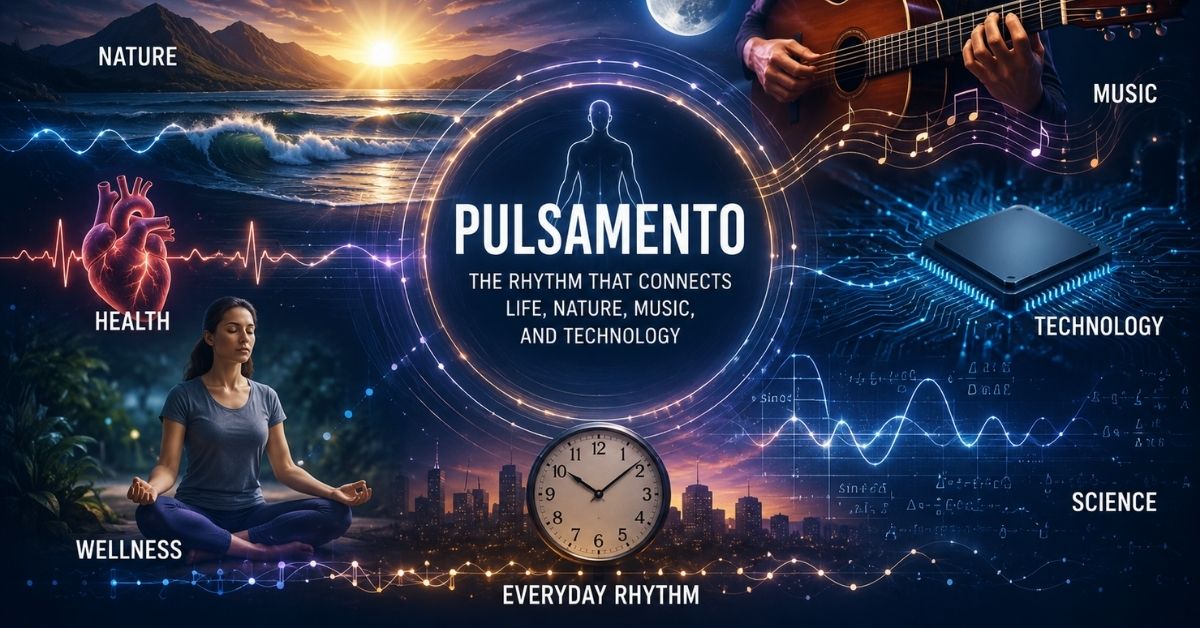
Have you ever noticed how everything around us follows a rhythm? Your heartbeat, your breathing, the changing seasons, and even the music you enjoy all move in repeating patterns. The idea behind pulsamento reflects this natural rhythm. Although the term is not widely recognized in everyday English, it has gained attention because it describes the steady pulse or recurring movement found in nature, technology, music, and daily life.
Understanding pulsamento helps us see how rhythm influences the way systems function, how people create art, and even how our bodies maintain balance. This guide explains the meaning of the term, its origins, practical applications, and why it continues to interest people across different fields.
What Is Pulsamento?
Pulsamento refers to a continuous pulse, rhythmic movement, or repeated cycle. It describes something that moves with consistency instead of randomness. Whether it is the beat of a song, the flow of electrical signals, or the rhythm of a heartbeat, the concept revolves around regular repetition.
Unlike technical terms that belong to one profession, pulsamento is flexible. It can describe physical movement, creative expression, biological functions, or digital communication. This broad meaning makes the word useful when discussing anything driven by rhythm and timing.
The Origin of the Word
The word has roots in Romance languages, where similar words relate to pulsing, beating, or rhythmic movement. It shares its foundation with words connected to pulse and pulsation, both of which describe repeated motion or vibration.
Today, the term is often used in educational discussions, creative writing, and online articles to explain how rhythm appears in different areas of life. While it is not a standard scientific term, its meaning is easy to understand because it builds on familiar ideas.
Why Rhythm Is Important
Rhythm is more than a musical concept. It creates order in situations where consistency matters. Without rhythm, many natural and mechanical systems would struggle to function correctly.
Think about daily life. People naturally develop routines for sleeping, eating, working, and exercising. These patterns improve productivity and reduce unnecessary stress. The same principle applies to machines, communication networks, and biological systems.
Understanding pulsamento encourages us to recognize these repeating patterns instead of viewing them as isolated events.
Pulsamento in Music
Music is one of the easiest ways to understand rhythmic movement. Every song depends on a steady beat that helps listeners follow the melody and musicians stay synchronized.
Whether someone plays the guitar, piano, or drums, maintaining a consistent pulse allows the performance to sound balanced. If the rhythm constantly speeds up or slows down without intention, the music becomes difficult to follow.
For this reason, music teachers often encourage students to develop a strong sense of timing before learning advanced techniques. Good rhythm creates confidence and improves overall performance.
How It Appears in Nature
Nature operates through countless repeating cycles. Day changes into night. Seasons arrive in predictable order. Ocean tides rise and fall according to natural forces.
Living organisms also depend on rhythmic processes. Breathing, circulation, and sleeping all follow patterns that help maintain healthy body functions. When these rhythms become disrupted, people often experience fatigue, stress, or reduced performance.
Looking at nature through the idea of pulsamento helps explain why consistency is essential for life itself.
The Role in Human Health
Medical professionals regularly monitor rhythm to evaluate health. Heart rate, breathing patterns, and blood circulation all provide important information about a person’s condition.
Although healthcare rarely uses the word pulsamento as a technical diagnosis, the underlying concept remains relevant. Regular body rhythms often indicate that important systems are functioning properly, while irregular patterns may require further attention.
Simple habits such as regular exercise, quality sleep, stress management, and balanced nutrition help support healthy biological rhythms over time.
Pulsamento in Technology
Technology depends heavily on precise timing. Computers process information through electrical signals that follow carefully controlled sequences. Networks send data in organized packets, while digital devices rely on internal clocks to coordinate millions of operations every second.
Without predictable timing, modern technology would become unreliable. Information could arrive late, become corrupted, or fail to reach its destination.
The idea of pulsamento provides an easy way to understand why repeated, organized signals are essential for digital communication and electronic systems.
Scientific Perspective
Scientists frequently study repeating movements because they reveal how natural systems behave. Waves, vibrations, sound frequencies, and oscillations all demonstrate predictable patterns that can be measured and analyzed.
These patterns help researchers improve communication systems, develop medical equipment, design safer buildings, and better understand natural phenomena.
Although different scientific disciplines use specialized terminology, the central idea remains the same: repeating motion creates stability and allows accurate observation.
Creativity and Personal Expression
Creative work also benefits from rhythm. Writers establish pacing through sentence structure. Painters repeat shapes and colors to guide attention. Dancers coordinate movement with music, while filmmakers control scene timing to create emotional impact.
Creative rhythm is not about following strict rules. Instead, it helps audiences connect naturally with the work. Balanced pacing makes stories easier to enjoy and ideas easier to remember.
Understanding pulsamento reminds creators that rhythm exists beyond music and influences nearly every form of artistic expression.
Everyday Examples
Many everyday activities demonstrate rhythmic movement without us realizing it.
Walking follows repeated steps that keep us balanced. Cooking often involves timed actions that improve results. Athletes practice movements repeatedly until they become automatic. Even conversations have natural pauses and pacing that make communication comfortable.
Recognizing these familiar examples makes the concept easier to understand because it connects an unfamiliar word with experiences everyone already knows.
Common Misunderstandings
Some people assume the term refers only to the human pulse or heartbeat. Others believe it belongs exclusively to music or science.
In reality, the concept is much broader. It represents any organized pattern that repeats consistently over time. This flexibility explains why the word appears in discussions about technology, creativity, health, education, and natural systems.
Understanding this wider meaning prevents confusion and helps readers apply the idea in different contexts.
Why the Concept Matters Today
Modern life often feels fast and unpredictable. Yet behind the complexity, nearly every successful system depends on consistent patterns.
Businesses follow schedules. Transportation relies on timing. Digital communication depends on synchronized signals. Healthy lifestyles benefit from stable routines. Creative projects improve through thoughtful pacing.
Learning about pulsamento offers a simple way to appreciate the importance of rhythm across many areas of life. It encourages us to notice the repeating structures that support both natural and human-made systems.
Conclusion
Although the word may not be familiar to everyone, pulsamento represents a timeless idea: rhythm creates stability, balance, and continuity. From music and science to technology and personal well-being, repeating patterns help systems function smoothly and predictably.
By understanding this concept, readers can better appreciate how rhythm shapes everyday experiences. Whether you are learning music, improving your daily routine, exploring science, or simply becoming more aware of the world around you, the principles behind pulsamento offer a practical way to understand how consistency influences success.
FAQs
What does pulsamento mean?
Pulsamento describes a steady pulse, rhythm, or repeating movement found in nature, music, technology, and everyday life.
Is pulsamento a scientific term?
Not officially. It is more commonly used as a descriptive concept that explains rhythmic patterns across different subjects.
How is pulsamento connected to music?
It represents the steady beat or pulse that helps musicians maintain timing and perform together consistently.
Can pulsamento relate to human health?
Yes. The idea connects with natural body rhythms such as heartbeat, breathing, and other repeating biological processes.
Why is pulsamento important?
It helps explain how rhythm and repetition support stability, organization, creativity, communication, and many natural processes.
You May Also Read: Keine karriere-subdomain gefunden: a simple guide to fix it and keep your career page running